

Social Media and Marketing: Why They Must Work Together, Not in Silos
February 3, 2026
8
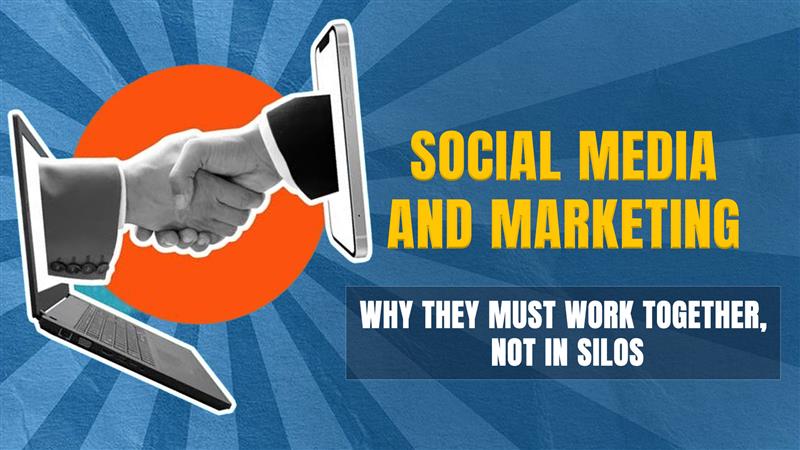
There is a conversation happening in marketing teams around the world, and it usually sounds something like this: the social media manager wants to post a reel, the email team is pushing a different campaign, the paid ads team is running its own creative, and nobody is talking to each other. Sound familiar?
This is the silo problem, and it is quietly costing brands more than they realise.
Social media and marketing are not two separate departments with separate goals. They are two sides of the same coin, and when they operate independently, the brand message fractures, budgets get wasted, and customers receive a disjointed experience that erodes trust over time.
This post breaks down exactly why social media and marketing must be treated as a unified function, what happens when they are not, and how brands of every size can start closing the gap today.
Why Social Media Is Not a Standalone Channel
The Misconception That Keeps Teams Stuck
For a long time, social media was treated as a broadcasting tool. Post something, get some likes, feel good about it. But that thinking belongs to 2013. Today, social media is a full-funnel channel that touches awareness, consideration, conversion, and retention simultaneously.
When social is treated as an afterthought, or handed off to a junior team member to "just post stuff," it becomes disconnected from the actual business goals. Meanwhile, the rest of the marketing team is building email sequences, optimising landing pages, and running paid campaigns, all without factoring in what the social audience actually responds to.
The result is a brand that feels inconsistent. The Instagram page says one thing. The newsletter says another. The website tells a different story entirely. Customers notice this, even if they cannot articulate it. It shows up in lower engagement, weaker conversion rates, and a general sense that the brand does not quite know who it is.
What Integrated Strategy Actually Looks Like
When social media and marketing work together, every touchpoint reinforces the same message. A product launch does not just go out in an email blast. It is teased on social. It has a supporting paid campaign. The content team creates assets that work across every format. The social team feeds insights back to the broader marketing team about what language and visuals are landing.
This kind of integration is not complicated in theory, but it requires intention. It requires shared goals, shared data, and a shared understanding of the customer journey.
The Real Cost of Running in Silos
Budget Inefficiency and Missed Opportunities
When social and marketing operate separately, teams often end up duplicating effort. The design team creates assets for email that the social team never uses because they were not looped in early enough. The social team creates content that could have supported a paid campaign but nobody made the connection in time.
Every one of those missed handoffs is money and time left on the table.
Beyond efficiency, there is the issue of attribution. When campaigns are fragmented, it becomes nearly impossible to understand what is actually driving results. Was it the email? The Instagram story? The Google ad? Without integrated tracking and a unified strategy, you are essentially guessing, and guessing is not a growth strategy.
Brand Inconsistency and Customer Confusion
Customers today interact with brands across multiple channels before they make a purchase decision. Research consistently shows that it takes multiple touchpoints before someone converts, and those touchpoints span social, search, email, and more.
If a customer sees a playful, casual brand voice on TikTok and then receives a stiff, formal email the next day, there is a disconnect. It creates subtle doubt. Is this the same brand? Do they know what they are doing?
Consistency builds trust, and trust builds conversions. That consistency is only achievable when social and marketing are working from the same playbook.
How Social Media Supercharges Every Marketing Function
Content Marketing Gets a Distribution Engine
One of the most underused benefits of aligning social and marketing is what it does for content. A well-researched blog post does not have to live and die on the website. It becomes a carousel on LinkedIn. A short clip for Instagram Reels. A quote card for Twitter. A teaser for the email newsletter that drives traffic back to the full post.
This is not repurposing content lazily. It is strategic amplification. You create once and distribute intelligently, meeting your audience where they already are.
If your team is struggling to figure out how to make this work systematically, it may be worth looking at how a dedicated agency can help you build that system. Foxtale Media works with brands to build content ecosystems where every piece of content has a purpose and a distribution plan. You can explore how that works at https://foxtalemedia.com/services.
Email Marketing Gets Smarter Segmentation
Social media is one of the richest sources of audience data available to marketers. You can see what content your audience engages with, what questions they ask in comments, what pain points come up repeatedly, and what language they use to describe their problems.
When the email team has access to these insights, segmentation becomes sharper. Instead of sending the same newsletter to your entire list, you can tailor messaging based on what you know your audience actually cares about, informed directly by social listening.
This feedback loop between social and email is one of the most powerful and most overlooked tools in a marketer's arsenal.
Paid Advertising Gets Better Creative
Paid social advertising is one of the fastest ways to scale reach, but the creative is everything. And here is the thing: the best performing ad creative almost always comes from organic content that has already proven itself.
When the social team and the paid team are working together, there is a natural testing ground. You can see which organic posts get the highest engagement, pull that content into paid campaigns, and know going in that the messaging already resonates.
Brands that separate their organic and paid social functions miss this completely. They end up spending significant budget testing creative from scratch when the answer was already sitting in their analytics.
Building a Unified Social and Marketing Strategy
Start With Shared Goals, Not Separate KPIs
One of the clearest signs that social and marketing are operating in silos is when each team has entirely different KPIs that do not connect to a common business objective.
The social team is chasing follower growth. The marketing team is focused on lead generation. Nobody is asking whether follower growth is actually contributing to lead generation or revenue.
The fix starts with leadership bringing both functions to the table and asking a simple question: what does success look like for the business, and how does each channel contribute to that? From there, you can build KPIs that are complementary rather than competing.
Create a Unified Content Calendar
A shared content calendar is one of the most practical tools for breaking down silos. When every campaign, launch, event, and piece of content is visible to everyone, teams can plan in coordination rather than in isolation.
The email team knows what is going live on social this week. The social team knows when a new blog post is dropping and can build supporting content around it. The paid team sees the full picture and can allocate budget to amplify the moments that matter most.
This does not require expensive software. A shared Google Sheet or Notion board can accomplish the same thing if everyone commits to actually using it.
Use Social Listening as a Marketing Intelligence Tool
Social listening is not just about monitoring mentions. It is about understanding your market. What are people frustrated about in your category? What language do they use to describe their problem? What are they saying about competitors?
This intelligence should not live only with the social team. It should feed directly into product marketing, content strategy, email campaigns, and even sales enablement.
Brands that treat social as a marketing intelligence function, not just a broadcasting channel, consistently develop sharper messaging and more relevant campaigns.
If you are not sure where to start with building this kind of system, Foxtale Media offers strategic services that bridge exactly this gap. From content strategy to campaign planning, the goal is always an integrated approach that makes every channel stronger. Take a look at what is available at https://foxtalemedia.com/services.
Invest in Cross-Functional Collaboration
The silo problem is often a structural one. Teams are built, managed, and incentivised separately, so they behave separately. Fixing this requires deliberate cross-functional collaboration.
Some practical ways to do this include holding weekly syncs that include both social and broader marketing stakeholders, building shared dashboards where everyone can see performance across channels, creating a process where social insights are formally fed into campaign planning, and rotating ownership of campaign briefs so no single team works in isolation.
None of these are radical ideas, but they require consistency and buy-in from leadership to stick.
Real-World Examples of Integration Done Right
Product Launches That Actually Build Momentum
Think about the last time you saw a brand launch something and felt genuinely excited about it. Chances are, it was not because of one email or one post. It was because you saw it everywhere, and it all felt cohesive.
That is what integrated strategy looks like in practice. A countdown on Instagram stories. A teaser email to the list. Behind-the-scenes content on TikTok. A targeted paid campaign to a warm audience. A landing page that speaks the same language as all of the above.
Each channel is doing its part, but they are all pulling in the same direction.
Community Building That Feeds the Funnel
Brands that use social media to build genuine community, rather than just broadcast promotions, create a powerful asset that the rest of marketing can leverage.
A loyal, engaged social community is a ready-made audience for email sign-ups. It is a testing ground for new product ideas. It is a source of user-generated content that can power paid campaigns. It is a pool of potential brand advocates who will amplify your message organically.
But this only works when social community building is treated as a strategic marketing priority, not a nice-to-have.
The Bottom Line
Social media and marketing are not separate disciplines that occasionally collaborate. They are deeply interconnected, and brands that treat them as one unified function consistently outperform those that do not.
The brands winning right now are the ones where the social team understands the broader marketing objectives, and the marketing team understands what the social audience actually responds to. They share data, share goals, and share a content strategy that makes every channel stronger because of the others.
If your team is still operating in silos, the good news is that the fix is more about intention and structure than technology or budget. It starts with deciding that integration is a priority, and then building the habits and processes that make it real.
For brands that want support building a strategy where social and marketing work as one, Foxtale Media specialises in exactly that. The focus is always on building systems that create compounding results across every channel, not just quick wins that fade. See how Foxtale Media can help your brand at https://foxtalemedia.com/services.
Related Blog

October 20, 2026
8
How to Use User-Generated Content to Build Trust Without a Big Budget
.jpg)
October 19, 2026
8
%201.svg)