

Most marketing videos that underperform have something in common: the problems were visible long before the camera started rolling. A weak hook, a muddled message, a call to action that feels disconnected from everything that came before it. These are not production problems. They are planning problems, and they are exactly the kind of problems that storyboarding exists to solve.
Storyboarding is one of the most underused tools in marketing video production. It is standard practice in film and advertising, but in the broader world of brand and digital marketing video, it often gets skipped in favor of moving straight from script to shoot. The reasoning is usually about saving time. The reality is that skipping the storyboard almost always costs more time, not less, and it produces weaker videos as a result.
This guide walks through what storyboarding is, why it matters specifically for marketing videos that need to convert, and how to do it in a way that gives your production team everything they need to execute with precision.
What Is a Storyboard and Why Does It Matter for Marketing Video?
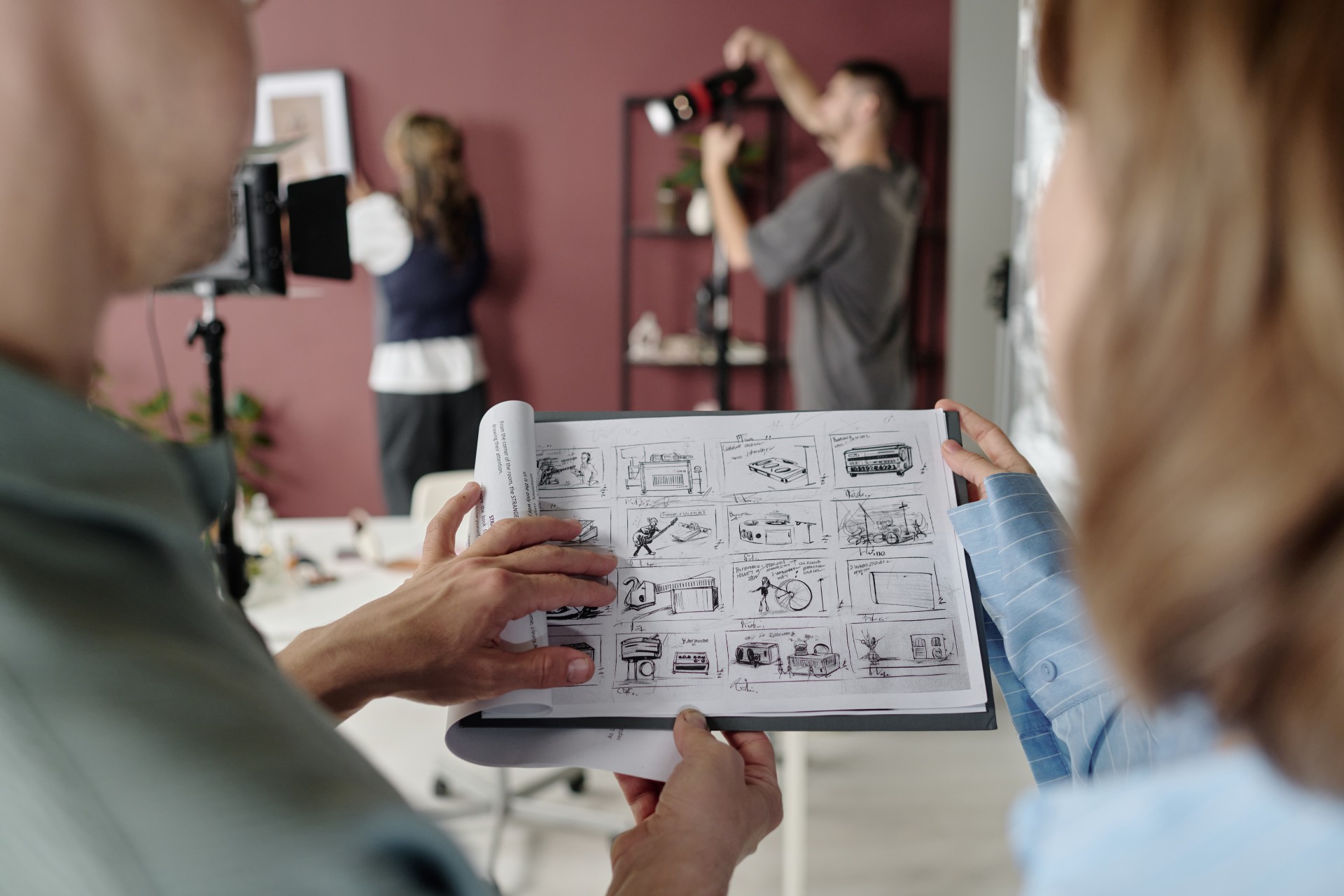
A storyboard is a sequence of illustrated or sketched frames that represent the visual progression of a video, scene by scene and shot by shot. Each frame typically includes a rough drawing of what will appear on screen, notes on camera angle and movement, dialogue or voiceover copy, and any relevant audio or action directions.
In the context of marketing video, a storyboard serves as the visual blueprint for everything that follows. It translates a script or concept from words on a page into a visual sequence that everyone involved in the production, from the director and cinematographer to the editor and client, can see, evaluate, and align on before a single frame is filmed.
The Gap Between Script and Screen
A script tells you what will be said. A storyboard shows you what will be seen. These are two very different things, and the gap between them is where most marketing video problems originate.
A script might read: "The customer opens their laptop and smiles as they see the results." That sounds straightforward. But what kind of shot is this? Wide or close? Over the shoulder or front-facing? What is in the background? What does the lighting feel like? What comes immediately before and after this moment, and does the cut between them work visually?
None of these questions can be answered by a script alone. The storyboard is where they get resolved, which is why teams that skip it consistently find themselves making those decisions under pressure on set, where time is expensive and changing your mind is difficult.
Why Conversion Depends on Visual Planning
For a marketing video to convert, it needs to do several things in sequence: capture attention immediately, maintain it through sustained visual interest, communicate a clear message, build toward a logical emotional or rational conclusion, and deliver a call to action that feels earned rather than imposed.
Every one of those stages is a visual experience as much as a verbal one. The pacing of cuts, the progression of shot types, the visual emphasis given to key moments, and the design of the final frame where the CTA appears all affect whether the video converts. Storyboarding is the stage where you design that visual experience deliberately, rather than hoping it comes together in the edit.
How Storyboarding Improves Every Stage of Video Production
The benefits of storyboarding are not limited to the planning phase. A well-constructed storyboard improves execution and outcomes across the entire production process.
Pre-Production: Alignment Before Anything Is Built
The pre-production phase is where the storyboard does its most important work. By visualizing the entire video before production begins, you create a shared reference point that keeps every stakeholder aligned on what is being made.
This is particularly valuable in marketing contexts where multiple people, brand managers, creative directors, agency teams, and clients, all have a stake in the outcome. Without a visual reference, everyone tends to have a slightly different version of the video in their head, and those differences only reveal themselves when the first cut comes back from the edit. At that point, changes are expensive.
A storyboard surfaces those differences early, when they are cheap to fix. A scene that does not serve the campaign's objective can be cut at the storyboard stage in five minutes. Cutting it after it has been filmed and edited takes significantly longer and costs significantly more.
Production: A Shooting Blueprint That Saves Time on Set
On shoot day, time is the most precious resource. Crews are booked, locations are locked, and every hour that runs over budget erodes the quality of what gets made. A detailed storyboard eliminates the guesswork that wastes that time.
When a director arrives on set with a storyboard, the shot list is already determined. The camera angles, the movements, the sequence of setups, and the coverage needed for the edit are all mapped out in advance. The team can move through the day with efficiency and confidence rather than improvising decisions that should have been made weeks earlier.
Storyboarding also helps identify logistical challenges before they become on-set surprises. A frame that requires a specific lighting setup, a particular location angle, or a piece of equipment that was not in the original plan is much easier to accommodate when you have three weeks of pre-production ahead of you than when you are standing on a set with a crew waiting.
Post-Production: Editing With a Clear Destination
Editors work best when they know what they are editing toward. A storyboard gives the editing team a visual map of the intended sequence, which makes the assembly cut faster and the revision process more focused.
Without a storyboard, editing becomes an interpretive exercise. The editor makes judgment calls about pacing, sequence, and emphasis based on the footage available and their own creative instincts. Some of those calls will be right. Others will not match what the director or the brand had in mind, leading to revision rounds that could have been avoided.
With a storyboard as the reference, the first cut is already oriented in the right direction. Revisions become refinements rather than redirections.
A Step-by-Step Guide to Storyboarding a Marketing Video
Understanding the value of storyboarding is one thing. Knowing how to do it effectively is another. Here is a practical process for creating a storyboard that actually serves your marketing video production.
Step One: Lock the Script and Core Message Before You Draw Anything
Storyboarding before the script is finalized is one of the most common mistakes in video pre-production. The storyboard exists to visualize the script, so any ambiguity at the script stage will multiply at the storyboard stage.
Before you begin storyboarding, confirm that the script is approved, the core message is clear and singular, and the call to action is defined. These are the anchors that every visual decision in the storyboard should serve.
If the script is still in flux, hold the storyboard. The time it takes to finalize the script is always less than the time it takes to redo a storyboard because the script changed.
Step Two: Break the Script Into Scenes and Shots
Go through the script and identify the natural scene breaks, the moments where the location, the subject, or the visual context changes in a meaningful way. Within each scene, identify the individual shots needed to tell that part of the story.
Think in terms of shot types: wide shots that establish context and environment, medium shots that show body language and interaction, close-ups that create intimacy and emphasis. Marketing videos that convert tend to use close-ups strategically around moments of key emotion or product demonstration, because that is where visual emphasis drives engagement.
For each shot, note the camera angle (straight on, low angle, high angle, over the shoulder) and any camera movement (static, pan, track, handheld). These choices affect how the viewer feels about what they are seeing, not just what they see.
Step Three: Sketch the Frames
The storyboard frames do not need to be works of art. Stick figures and rough shapes are entirely sufficient for communicating what needs to be in frame, where the subject is positioned, what the camera is doing, and how the shot relates to the one before and after it.
What matters is clarity and completeness. Every frame should communicate enough visual information that someone who has not read the script can understand what is happening on screen, why this shot exists, and how it connects to the broader sequence.
If your team includes a designer or illustrator, more polished storyboard frames can be valuable for client presentations or for animated and motion graphic content where the visual design itself needs to be approved before production begins. But for live-action shoots, rough frames that communicate intent are completely adequate.
Step Four: Add Timing, Audio, and Action Notes
Below or beside each frame, include the following: the estimated duration of the shot, the associated voiceover or dialogue line, any music or sound design notes relevant to that moment, and any on-screen text, graphics, or captions that need to be designed for the frame.
This is where the storyboard becomes a genuinely comprehensive production document rather than just a visual sketch. Timing notes help the editor understand the intended pace. Audio notes ensure the sound design supports the visual intention. On-screen text notes flag design work that needs to be completed before the edit.
For brands running content marketing campaigns that include video across multiple platforms, these notes are also where platform-specific adaptations get flagged. A frame designed for a 16:9 YouTube video will need to be reconsidered for a 9:16 Instagram Story, and identifying those adaptations at the storyboard stage is far more efficient than discovering them in post.
Step Five: Review the Storyboard as a Complete Sequence
Once all the frames are complete, review the storyboard from beginning to end as a continuous sequence, not frame by frame in isolation. You are looking for the same things a viewer will experience: Does the opening frame create an immediate reason to keep watching? Does the visual story progress logically and with the right pacing? Do the cuts between shots feel natural or jarring? Does the final frame set up the call to action in a way that feels earned?
This review stage often surfaces issues that were not visible when looking at individual frames. A scene that works in isolation might feel tonally inconsistent with the scene before it. A cut that seemed logical in the script might not work visually. A moment that was intended to be high-energy might look flat given the planned shot choices.
Fix these issues now. This is the cheapest point in the entire production process to make changes.
Step Six: Share, Gather Feedback, and Lock It
Present the storyboard to all relevant stakeholders before production begins and gather consolidated feedback in a single round. This is important: storyboard feedback should be collected and addressed once, not in an ongoing series of individual conversations that create conflicting directions.
Once feedback is incorporated and the storyboard is approved, lock it. Changes after the storyboard is locked should be treated as scope changes with implications for timeline and budget, because at that point they almost certainly have both.
Storyboarding for Different Types of Marketing Videos
The storyboarding process applies across all marketing video formats, but the emphasis shifts depending on the type of content being made.
Explainer Videos and Product Demos
For explainer videos, the storyboard is primarily about information architecture. Each frame should correspond to a specific idea or feature being communicated, and the sequence should build understanding in a logical progression. Visual metaphors and diagram-style sequences deserve particular attention at the storyboard stage, because these are the moments most likely to confuse viewers if they are not designed clearly.
Social Media Video Ads
For short-form social ads, the storyboard's most important work happens in the first two or three frames. These represent the first three seconds of the video, where the vast majority of viewer drop-off decisions are made. Every creative option for the opening should be storyboarded and evaluated before a direction is chosen.
For brands building digital marketing campaigns that include paid social video, investing time in storyboarding multiple hook options and testing them against each other is one of the highest-return activities available in the pre-production process.
Brand Films and Storytelling Videos
For longer-form brand content, the storyboard needs to manage emotional pacing as well as visual pacing. The arc of the viewer's emotional experience, where they feel curious, where they feel connected, where they feel inspired, should be mapped across the storyboard sequence and evaluated deliberately before production begins.
The Bottom Line
Storyboarding is not an extra step. It is the step that makes every other step more effective. It turns a script into a shared visual language, surfaces production challenges before they cost money, and gives editors a clear destination to edit toward.
The marketing videos that consistently convert are not the result of exceptional luck on set. They are the result of exceptional planning before the set is ever built. Storyboarding is where that planning happens, and skipping it is one of the most reliably expensive shortcuts a production team can take.
Foxtale Media approaches every video project with the same conviction: great execution starts with great planning, and the storyboard is where planning becomes production-ready. If you want to build marketing videos that hold attention and convert viewers into customers, visit Foxtale Media and let's start by planning it properly.
Related Blog

October 8, 2026
8

%201.svg)