

Digital Marketing Services Explained: What an Agency Actually Delivers
April 13, 2026
8
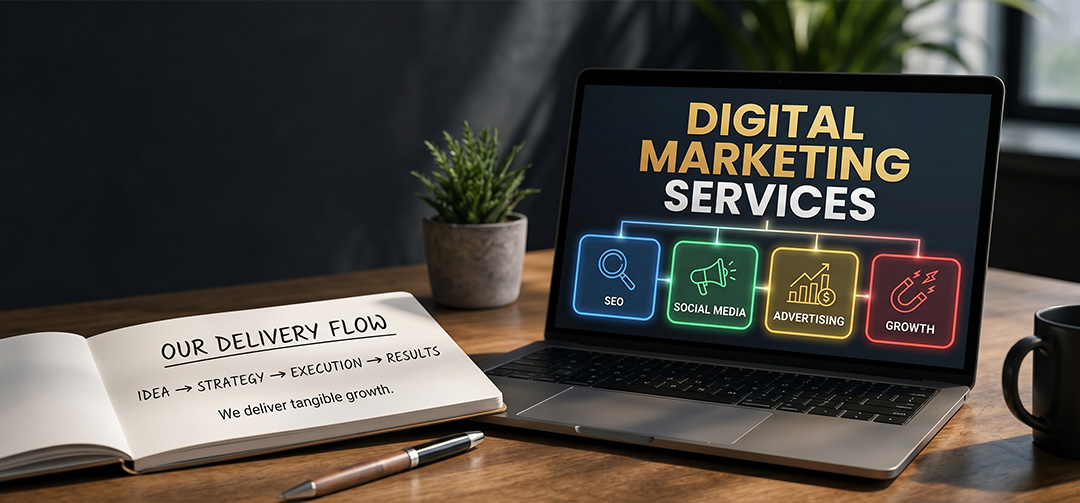
If you have ever signed a contract with a digital marketing agency and then wondered, three months later, what you were actually paying for, you are not alone. The phrase "digital marketing services" gets used so loosely that it can mean a single freelancer running your Instagram or a full team handling search, paid media, content, email, and analytics across every channel your customers touch. The gap between those two realities is enormous, and it is usually the reason brands feel disappointed by agency relationships.
This guide breaks down exactly what a competent agency delivers, channel by channel, along with the team behind the work, what it tends to cost in India, and how to tell whether the money is producing anything. By the end, you should be able to read a proposal and know whether it describes real, measurable work or just a list of buzzwords.
What Digital Marketing Services Actually Mean
Digital marketing is the practice of reaching, converting, and retaining customers through online channels. That is the textbook definition, but it tells you almost nothing about the daily work. In practice, a digital marketing service is a repeatable system: research, strategy, execution, measurement, and iteration applied to one or more channels with the goal of moving a business metric.
The key word is system. A one-off campaign is not a service. A service is the ongoing machinery that produces leads, sales, or brand awareness on a predictable basis. When an agency like Foxtale Media takes on a client, the deliverable is not "some posts" or "some ads." It is a structured engine with inputs you can see, outputs you can measure, and levers the team can pull when results dip.
Most agencies bundle their offerings into a handful of core categories. Understanding each one separately is the fastest way to evaluate whether a proposal is complete or full of holes.
Search Engine Optimization: The Long Game
SEO is the work of making a website rank higher in unpaid search results so it earns traffic without paying per click. It is the channel most often misunderstood, partly because results take months and partly because a lot of agencies hide vague work behind it.
What Real SEO Work Includes
Legitimate SEO breaks into three pillars. Technical SEO covers the plumbing: site speed, mobile usability, crawlability, structured data, indexing, and fixing the errors that quietly stop Google from understanding your pages. On-page SEO covers the content itself: keyword research, page structure, internal linking, title tags, and matching content to what searchers actually want. Off-page SEO covers authority signals, primarily backlinks earned from other reputable sites.
A serious agency will show you a technical audit before promising rankings. They will map keywords to a content calendar, explain which terms are realistically winnable, and set expectations that meaningful movement usually takes four to nine months. If a provider guarantees page-one rankings in thirty days, treat that as a warning sign rather than a selling point. The teams worth working with, including the SEO specialists at Foxtale Media, will tell you the timeline honestly even when it is not what you want to hear.
How to Judge SEO Deliverables
Ask for the monthly outputs in writing. A healthy SEO engagement produces a defined number of optimized pages or articles, a backlink acquisition target, technical fixes logged in a tracker, and a monthly report tying activity to organic traffic and keyword movement. If the only deliverable is "we improved your SEO," you have no way to verify anything.
Pay-Per-Click and Paid Media: Buying Attention Profitably
Where SEO is patient, paid media is immediate. You pay platforms like Google, Meta, LinkedIn, or YouTube to put your message in front of a targeted audience, and you can see results within days. The skill is not in spending money. The skill is in spending it so that each rupee returns more than a rupee.
The Components of Paid Media Management
Running profitable paid campaigns involves account structure, audience research, keyword and placement selection, ad creative, bid strategy, landing page alignment, and constant optimization. A campaign that converts is the product of dozens of small decisions: which audiences to exclude, which keywords waste budget, which headline lifts click-through rate, and which landing page actually closes the sale.
A capable team treats your ad budget as separate from their fee and is transparent about both. They will A/B test creatives, prune underperforming keywords weekly, and adjust bids based on conversion data rather than vanity clicks. Crucially, they connect ad spend to revenue, not just to impressions. When you work with a paid media team at Foxtale Media, the conversation should always come back to cost per acquisition and return on ad spend, never to how many people merely saw the ad.
Watching the Real Numbers
The metrics that matter in paid media are cost per click, click-through rate, conversion rate, cost per acquisition, and return on ad spend. A good agency reports all five and explains the trade-offs between them. A lower cost per click is meaningless if those clicks never convert, and a high return on ad spend on a tiny budget may not scale. The judgment to read those tensions correctly is what you are paying a specialist for.
Content Marketing: The Fuel for Every Channel
Content marketing is the creation and distribution of useful material, blog posts, videos, guides, case studies, and more, designed to attract and retain an audience. It is the connective tissue of digital marketing because almost every other channel depends on it. SEO needs pages to rank. Paid ads need landing pages to send traffic to. Email needs something to say. Social needs something to post.
What a Content Service Produces
A real content service starts with strategy: who the audience is, what questions they ask, where they are in the buying journey, and what the brand can say that competitors cannot. From there it produces a content calendar, briefs, drafts, edits, and published assets on a reliable schedule. Quality content is researched, original, and structured for both readers and search engines.
The output should be concrete and countable. A content engagement might deliver eight blog posts, two long-form guides, and a set of social snippets every month, each tied to a keyword or campaign goal. The work also includes distribution, because content nobody reads has no value. If you want to see how strategy, search intent, and editorial quality come together in practice, the content team at Foxtale Media builds calendars around real audience demand rather than guesswork.
Social Media Marketing: Presence with a Purpose
Social media marketing is the work of building audience, engagement, and ultimately conversions on platforms like Instagram, LinkedIn, Facebook, X, and YouTube. It is the service clients most often assume is simple and most often get wrong, because posting frequently is easy and posting strategically is hard.
Organic Social Versus Paid Social
Organic social is the unpaid content you publish to your followers. It builds community, voice, and trust over time but reaches a shrinking percentage of followers as platform algorithms favor paid distribution. Paid social, covered partly under paid media above, uses budget to expand reach and target precisely. A complete social service handles both and explains where each fits.
The Daily Reality of Social Management
The deliverables include a content calendar, designed posts, captions, community management, hashtag and trend research, and performance reporting. Community management, the daily work of replying to comments and messages, is the part agencies most often quietly drop, so confirm whether it is included. Strong social management also means knowing each platform's culture: what works on LinkedIn falls flat on Instagram, and a team that posts identical content everywhere is not really managing your social presence.
Email Marketing and Automation: The Highest-Return Channel
Email remains one of the most profitable channels in digital marketing because it reaches people who have already raised their hands. Email marketing services cover list building, segmentation, campaign design, copywriting, automation, and deliverability management.
What Separates Good Email Work
Anyone can send a newsletter. The value is in automation and segmentation: welcome sequences that onboard new subscribers, abandoned-cart flows that recover lost sales, re-engagement campaigns that revive dormant contacts, and segmented broadcasts that send the right message to the right group. A capable team also watches deliverability, because emails that land in spam folders deliver nothing regardless of how good the copy is.
The reportable metrics are open rate, click rate, conversion rate, list growth, and unsubscribe rate. A well-run email program steadily grows a healthy list and produces revenue that is measurable down to the individual campaign.
Conversion Rate Optimization: Making the Traffic Count
Conversion rate optimization, or CRO, is the discipline of increasing the percentage of visitors who take a desired action. It is the service that quietly multiplies the value of everything else, because doubling your conversion rate has the same effect as doubling your traffic at a fraction of the cost.
CRO work includes analyzing user behavior through heatmaps and session recordings, identifying where visitors drop off, forming hypotheses, and running A/B tests on headlines, layouts, forms, and calls to action. It is methodical and data-driven, and it is one of the clearest signals that an agency thinks about results rather than activity. Agencies that offer CRO, including Foxtale Media, are usually the ones most serious about the bottom line rather than vanity metrics.
Analytics and Reporting: The Service That Makes the Rest Honest
Every channel above is only as good as the measurement behind it. Analytics services cover the setup of tracking, the configuration of tools like Google Analytics and tag managers, the definition of goals and conversions, and the regular reporting that ties activity to outcomes.
What Honest Reporting Looks Like
A trustworthy report connects work to business metrics. It shows traffic, leads, conversions, cost per result, and trends over time, with commentary explaining what changed and why. It does not bury you in disconnected numbers or celebrate metrics that do not affect revenue. The difference between a report that builds trust and one that erodes it is whether it answers a simple question: did the money produce a return.
If an agency cannot or will not give you clear, regular reporting tied to your goals, no other deliverable on the list matters, because you will never know whether it worked.
The Team Behind the Services
Digital marketing services are delivered by people, and understanding the roles helps you grasp what you are paying for. A full-service engagement typically draws on an account manager who owns the relationship, an SEO specialist, a paid media manager, content writers, a social media manager, a designer, and an analyst. In smaller setups one person may wear several hats, which is fine for smaller budgets but worth knowing so your expectations match the staffing.
What These Roles Cost in India
Understanding salary ranges helps you sanity-check agency pricing, because the fee has to cover skilled labor. In the Indian market, a junior digital marketing executive typically earns between 3,00,000 and 5,00,000 INR per year. A mid-level SEO or paid media specialist with a few years of experience usually falls between 6,00,000 and 12,00,000 INR annually. A senior specialist or campaign lead often commands 12,00,000 to 20,00,000 INR per year, and a marketing manager or head of growth can range from 18,00,000 to well over 35,00,000 INR depending on the company and city.
When an agency fee seems suspiciously low, these numbers explain why. Quality work requires experienced people, and experienced people are not cheap. A fee that cannot plausibly cover a skilled team usually means the work is being done by the most junior staff available or spread far too thin.
How Agencies Package and Price Their Services
Agencies generally use one of a few pricing models, and knowing them helps you read a proposal correctly.
Retainer pricing is the most common for ongoing services. You pay a fixed monthly fee for a defined scope of work, which suits SEO, content, and social where consistency matters. Project pricing covers one-off work like a website build or a campaign launch. Performance pricing ties part of the fee to results, which sounds attractive but requires careful definition of what counts as a result. Hourly pricing exists mostly for consulting or small tasks.
For most growing businesses in India, monthly retainers for digital marketing services range widely, from around 25,000 INR per month for a narrow single-channel scope to several lakh rupees per month for full-service work across many channels. The right number depends entirely on scope, and a good agency will scope the work to your goals rather than selling you a fixed package you may not need.
Questions That Reveal a Real Service
Before signing anything, ask what the specific monthly deliverables are, who on the team does the work, how performance is measured, how often you will receive reports, and what happens if results fall short. The answers separate agencies that sell systems from those that sell vague promises. A team confident in its process, the kind you will find when you talk to Foxtale Media, will answer these directly and put the commitments in writing.
Common Misconceptions Worth Clearing Up
A few myths cause most of the disappointment in agency relationships. The first is that results are instant. SEO and content compound over months, and even paid media needs a learning period before it optimizes. The second is that one channel is enough. The channels reinforce each other, and the strongest results come from a coordinated mix rather than a single tactic. The third is that more activity equals more results. Ten poorly targeted posts are worth less than one well-placed campaign, and a good agency optimizes for outcomes rather than output volume.
The final misconception is that the cheapest option saves money. Marketing that does not work is the most expensive marketing there is, because you pay the fee and get nothing in return. The real cost comparison is not fee against fee, it is return against return.
How to Choose the Right Agency for Your Needs
Match the agency to your stage and goals. A young business that needs leads quickly may prioritize paid media and CRO. An established brand building long-term authority may lean toward SEO and content. A company with a strong product but weak retention may need email and automation most. The right partner diagnoses your situation before prescribing a service, rather than selling the same package to everyone.
Look for transparency in reporting, clarity in deliverables, relevant case studies, and a team that asks about your business goals rather than just your budget. The agencies worth keeping treat your results as the measure of their own success. If you want a partner that builds measurable systems across search, paid, content, and analytics, exploring what Foxtale Media offers is a sensible place to start the conversation.
Key Takeaways
Digital marketing services are not a vague bundle of online activity. They are distinct, measurable systems: SEO for long-term organic growth, paid media for immediate targeted reach, content as the fuel for every channel, social for presence and community, email for high-return retention, CRO for multiplying the value of traffic, and analytics for making all of it honest. Each one has concrete deliverables you can demand in writing and metrics you can track.
The brands that get value from agencies are the ones that understand what they are buying. They know which channels fit their goals, they know what a real deliverable looks like, they know roughly what skilled work costs, and they insist on reporting that ties spend to return. Armed with that understanding, you can read any proposal clearly and choose a partner who delivers systems rather than slogans. When the work is structured
Related Blog
October 6, 2026
8
In-House vs Outsourcing SEO: Which Delivers Better Results?

September 11, 2026
8
%201.svg)