

Airport Advertising: Why Brands With a Premium Positioning Should Consider It
November 7, 2026
8
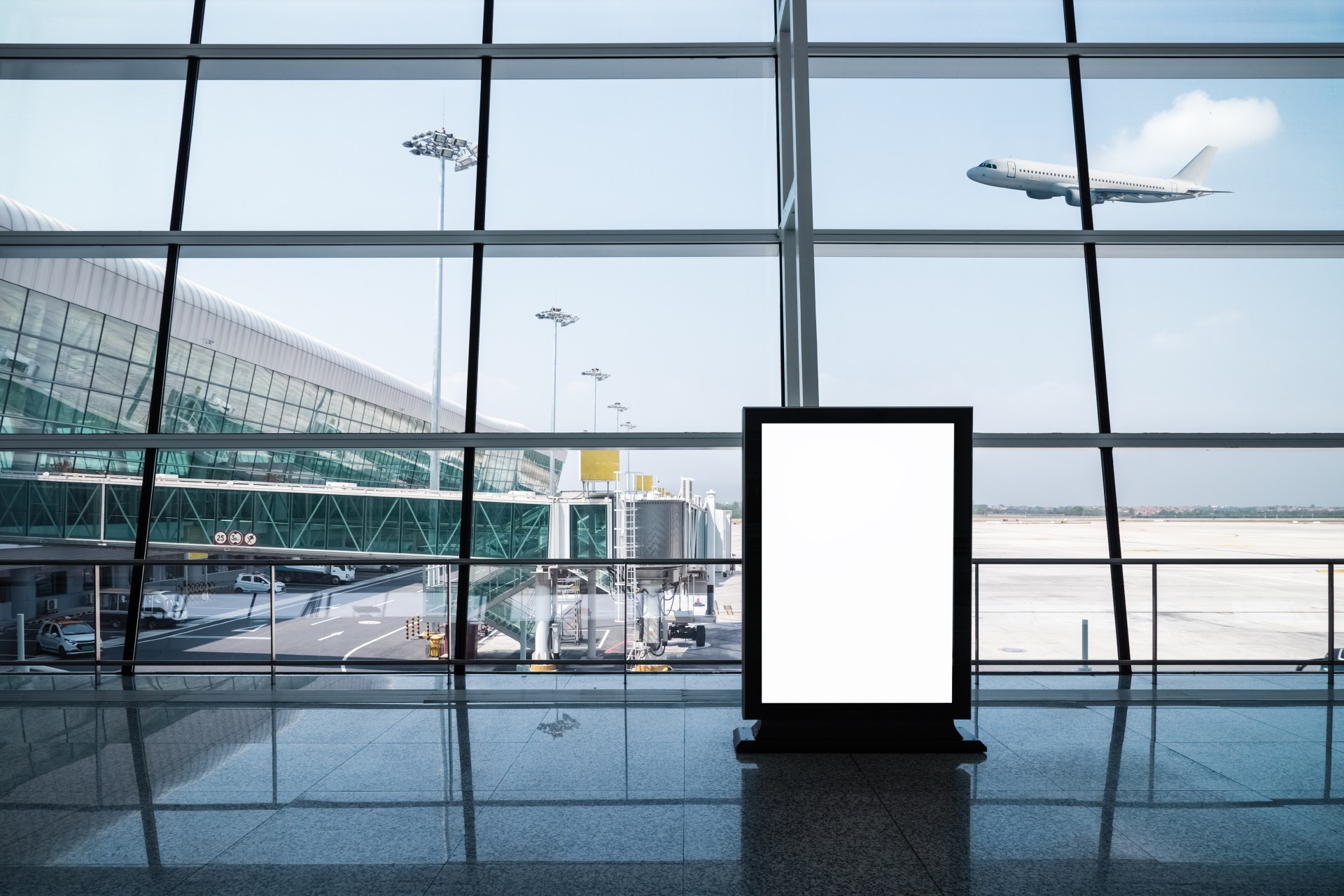
Out-of-home advertising is experiencing a broader resurgence, driven partly by digital fatigue and partly by improvements in format quality and measurement. Within OOH, airport advertising occupies a specific and distinctive position: it reaches a concentrated, captive, often high-value audience in an environment where the competitive noise of digital advertising is entirely absent and where the physical quality of the format can be executed at a level that is difficult to match anywhere else.
For brands with premium positioning — luxury goods, high-end financial services, premium travel and hospitality, B2B professional services, and others where the perceived status of the brand is commercially significant — airports are not merely a media placement. They are an environment whose associations actively reinforce the message the brand is trying to send.
This post examines what makes airport advertising distinct from other OOH environments, why the audience and contextual characteristics make it particularly effective for certain brand profiles, and what the practical considerations look like for a brand evaluating whether it belongs there.
The Airport Audience: Concentrated and Self-Selected
The fundamental commercial case for airport advertising rests on the audience. Business-class and first-class travellers, frequent flyers, senior executives, high-net-worth leisure travellers, and internationally mobile professionals are disproportionately represented in airport environments compared to almost any other out-of-home channel.
This self-selection is not incidental — it is structural. Access to major airport terminals, particularly premium zones such as business lounges, first-class check-in areas, and international departure zones, is determined by ticket class and frequent flyer status. The audience that passes through these areas has a higher average household income, higher average business seniority, and higher average spending capacity than the general population by a significant margin.
For brands whose products or services are priced at a premium, the efficiency of reaching this audience through airport media is significantly better than through general mass-market channels. A campaign that places ten thousand brand impressions in front of an economically general audience and ten thousand impressions in front of a concentrated premium audience is not equivalent — the latter may deliver ten times the commercially relevant impressions for the same gross reach.
Airports also reach international audiences who are less accessible through domestic media channels. For brands building presence in multiple markets simultaneously, or those whose target audience includes internationally mobile professionals and travellers, the cross-border reach of major international hub airports — Heathrow, Dubai International, Changi, JFK, Frankfurt — provides a scale and geographic spread that few other single channel placements can replicate.
Dwell Time: Attention in an Age of Scroll
One of the defining characteristics of airport advertising that separates it from most other OOH environments is dwell time. The average traveller spends between 90 minutes and three hours in an airport terminal before their flight. That dwell time creates an extended window for advertising exposure that is simply not available in most out-of-home contexts, where the typical format — a roadside billboard, a bus shelter, a transit car panel — is viewed in passing for seconds.
In an era where the defining challenge of advertising is capturing and holding attention against digital environments engineered to maximise scroll and reduce attention per post, the airport environment is structurally different. Passengers are waiting. The pace of their movement through the environment is measured, often slow, and frequently interrupted by queuing, sitting, and eating. The advertising environment exists in front of them not for a glance but for sustained periods.
This dwell time has implications for format and creative strategy. While a roadside billboard must communicate its message in two to five seconds of passing attention, an airport format can sustain a more complex, more detailed, more narrative creative execution. Large-format lightboxes in a terminal concourse, digital screens cycling through a campaign story, premium print placements in a business lounge — all of these can be encountered multiple times over the course of a single airport visit, with each encounter building on the previous one.
The frequency of exposure within a single visit is a media characteristic that advertisers pay significant premiums to achieve in digital environments through retargeting and frequency capping. In airports, it is an inherent property of the environment.
Environmental Association: The Luxury Context Effect
Advertising does not exist in a vacuum. The environment in which an advertisement appears communicates something about the brand regardless of the creative content of the advertisement itself. This context effect is well-documented in psychological research and is one of the factors that makes certain media placements disproportionately valuable for premium-positioned brands.
Airports — particularly premium zones within major international airports — are environments associated with mobility, success, international reach, and aspiration. The brands that are natively present in these environments — premium airlines, luxury watchmakers, high-end spirits, premium automotive, global financial institutions — are there in part because the association reinforces their positioning. Being seen in that context is itself a brand message.
For a brand seeking to build or reinforce a premium positioning, airport advertising provides a context alignment that is difficult to achieve in environments shared with the full spectrum of advertisers. A premium skincare brand advertising in a business lounge sits alongside Rolex, Emirates Business Class, and LVMH. The same brand advertising on a roadside billboard sits alongside fast food chains, local retailers, and loan comparison services. The context in which the brand appears shapes how it is perceived, and that contextual signal is part of what airport advertising delivers.
This context effect also works in reverse as a selection mechanism. The cost and profile of airport advertising means that the brands represented in premium airport environments are, almost by definition, brands with the resources and positioning to be there. The simple fact of appearing alongside those brands communicates something about the advertiser — a form of social proof through environmental association.
For businesses considering how OOH fits into a broader brand and media strategy, Foxtale Media's outdoor advertising team advises on environment selection, format planning, and campaign execution across the full range of OOH channels — including airport placements that align with specific audience and positioning objectives.
Format Quality: What Airport Environments Enable
The physical quality of advertising executions in premium airport environments is notably higher than in most other out-of-home settings. Major airports invest significantly in the aesthetic quality of their commercial environments, in part because the premium of their retail and advertising offerings depends on maintaining an overall sense of quality and curation.
The result is that airport media owners typically enforce standards for creative execution and production quality that are higher than other OOH environments. Large-format lightboxes are illuminated to precise standards. Digital screens are high-resolution and correctly calibrated. Premium print placements are produced at a level of quality appropriate for a luxury context.
For brands whose creative executions depend on colour fidelity, detail resolution, and production finish — luxury fashion, premium automotive, high-end spirits — the airport environment delivers a production standard that serves the creative more effectively than many outdoor formats. The difference between a fashion campaign photographed to a high standard and reproduced on a premium airport lightbox versus the same image reproduced on a standard outdoor sheet can be significant in terms of how the brand is perceived by the viewer.
Digital formats in airports also enable executions that are not possible in static outdoor environments: animated creative, dynamic content that updates based on time of day or flight information, sequential storytelling across multiple panels, and real-time content integration. These capabilities allow brands to bring a level of creative sophistication to OOH that static formats cannot accommodate.
Practical Considerations for Brands Evaluating Airport Advertising
Understanding what airport advertising can deliver is one part of the evaluation. Understanding the practical realities of planning and buying it is equally important.
Audience Targeting Within the Airport Environment
Not all parts of an airport have the same audience profile. The key segmentation dimensions are terminal and zone. International departure zones reach a different audience from domestic departures — the former tends to skew toward more frequent, more experienced travellers with higher average spend. Business and first-class check-in zones and their associated lounges reach a significantly more concentrated premium audience than general departure areas.
A campaign with a specific audience objective — reaching business class travellers, reaching internationally mobile executives — can be targeted by selecting placements in the zones where that audience is concentrated. This is more precise than broader airport-wide buys and typically commands higher CPMs, but delivers meaningfully higher commercial efficiency for the right brand.
Measurement and Attribution
Airport advertising shares the measurement challenges of other out-of-home channels: it is an impression medium, not a direct response medium, and attributing commercial outcomes to specific OOH placements requires methodological sophistication. Brand tracking studies, mobile device location data matched to airport visitors, and survey-based brand recall research are the standard measurement approaches for evaluating OOH performance, including airport placements.
For brands with longer sales cycles — premium automotive, luxury goods, high-end financial services — the measurement window for evaluating OOH effectiveness needs to reflect the duration of the consideration and purchase process. A campaign that runs for a quarter may contribute to purchases made in subsequent quarters; measurement frameworks need to account for that lag to avoid undervaluing the channel.
Campaign Duration and Booking Lead Times
Airport advertising inventory, particularly premium placements in major international hubs, books well in advance. Lead times of three to six months for premium inventory are common, and key periods — major business events, peak travel seasons, the run-up to Christmas — are often fully committed further in advance still.
Brands evaluating airport advertising should build planning timelines that reflect these lead times, particularly if they intend to run placements tied to specific events or seasonal moments. Last-minute airport buys are possible but typically involve what inventory remains rather than optimal positioning.
Integration With the Broader Media Plan
Airport advertising works best as part of an integrated media strategy rather than a standalone channel. The audience that encounters a brand in an airport environment is likely to also be reachable through digital channels — business media, LinkedIn, premium digital display, and streaming platforms over-index for the same high-value audience. Coordinated campaign messaging across airport OOH and digital touchpoints creates the multi-channel frequency that sustains and builds brand memory over time.
Airport OOH and high-quality digital content are complementary in a specific way: OOH creates large-format impressions that build salience and status associations; digital enables more targeted follow-up with specific messages and calls to action. The combination produces a more complete brand experience than either channel delivers alone.
Who Airport Advertising Is and Is Not For
Airport advertising is well-matched to brands with specific characteristics: a genuine premium positioning supported by premium pricing, a target audience that includes frequent international travellers or business-class flyers, a brand identity that benefits from association with mobility and international reach, and campaign objectives centred on brand building and status reinforcement rather than direct response.
It is less well-matched to brands targeting price-sensitive audiences, businesses with purely local or regional geographic scope, campaigns with short activation windows that cannot accommodate booking lead times, and brands whose creative approach does not benefit from the high-quality production environment of premium airport formats.
The question for any brand evaluating airport advertising is not whether the channel is prestigious — it clearly is — but whether the audience, the context, and the format capabilities align with the specific positioning and objectives of the campaign. For the right brand with the right positioning, it delivers a combination of audience quality, dwell time, and contextual association that is difficult to find elsewhere in the OOH landscape.
For businesses planning OOH campaigns and assessing how airport advertising fits alongside other outdoor and media channels, Foxtale Media provides planning and buying expertise across the full OOH environment — from site selection and format planning through to creative production and campaign measurement.
Where the Right Audience Is Waiting
The defining advantage of airport advertising for premium brands is not simply reach — it is the combination of who is there, how long they are there, and what the environment communicates about the brands that choose to appear in it. That combination is rare in a media landscape that has fragmented attention and distributed audiences across dozens of channels.
For the brands that belong in that environment, the investment returns something that most channels cannot: sustained, unhurried attention from the right audience, in a context that does the work of premium positioning before the creative has said a word.
Related Blog

November 12, 2026
8
How to Find the Right Influencer for Your Brand Without a Platform Subscription

November 11, 2026
8
